As AI adoption accelerated across retail, our team began exploring how advanced AI models could support demand forecasting. More than a year ago, we started developing an AI-based forecasting module with the goal of helping retail teams plan demand faster and more accurately.
Early testing, however, revealed an important challenge.
We ran multiple forecasting experiments using real sample data from a pilot client and compared the forecasts with subsequent actual sales. While the AI models identified useful patterns, their accuracy was not consistently strong enough for the level of precision required in retail demand planning.
One of the main limitations was the amount of historical sales data needed to generate dependable forecasts. AI models tend to perform best when they have extensive and consistent data to learn from. This can work well for established products, but retail businesses often manage products with limited or no sales history.
New SKUs may not have any historical data available. Seasonal products may only have a few relevant selling periods, while fast-fashion products can enter and leave the assortment before enough data is collected to support an accurate AI forecast. Promotions, markdowns, stockouts, changing trends, and short product life cycles can make forecasting even more challenging.
Building a Different Approach
These challenges led us to develop our own Expert-Built Forecasting Engine.
Rather than relying entirely on patterns identified by AI, the engine was built around proven retail demand-planning methods, industry standards, and more than 40 years of combined retail experience across our team. It considers factors such as seasonality, recent sales performance, product newness, and the amount of historical data available.
The engine also gives users the flexibility to adjust key forecasting metrics, calculation parameters, and planning rules so the system can better reflect their industry, product mix, and operating model. Instead of forcing every retailer into the same forecasting structure, Quantra allows teams to configure the engine around how their business actually plans and measures demand.
Our goal was not simply to automate forecasting. We wanted to create an engine that combines expert-driven methodology with the flexibility retailers need to make forecasting practical for their own operations.
Putting Both Approaches to the Test
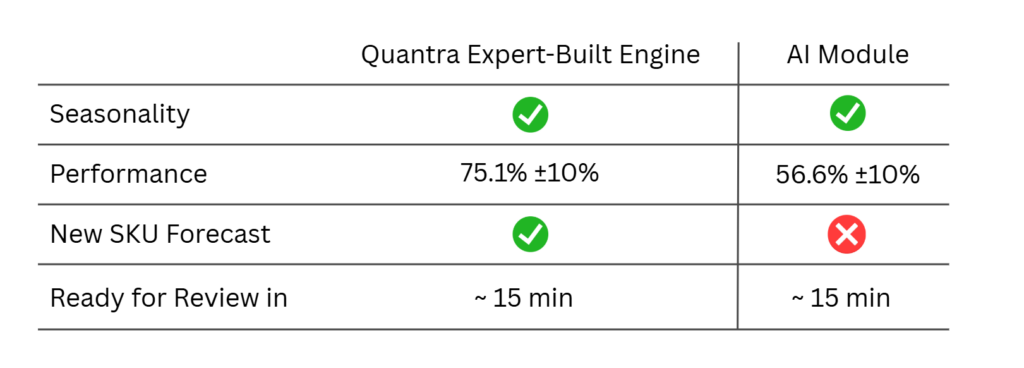
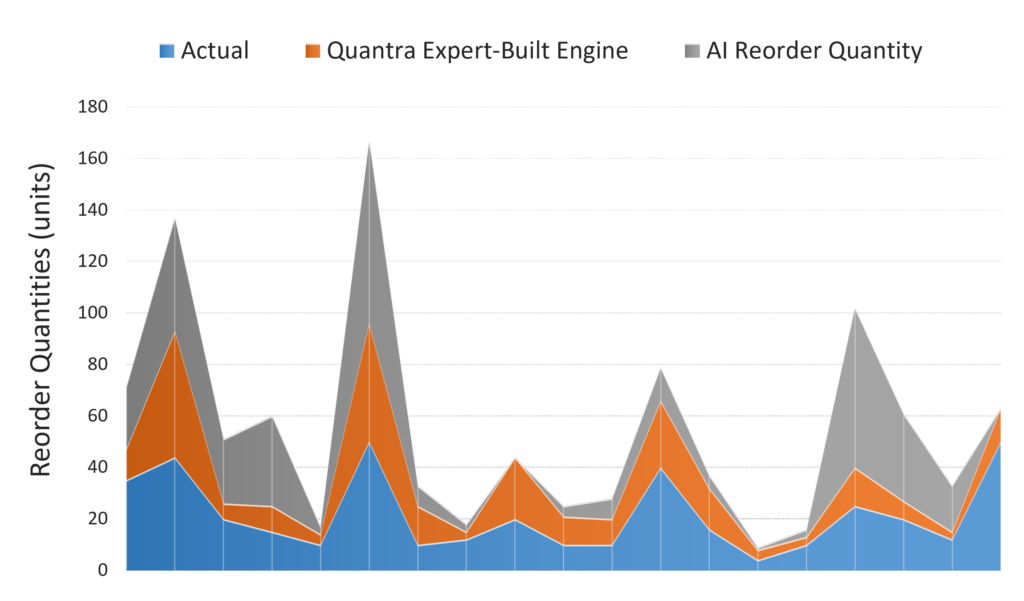
After more than a year of developing and testing both approaches, we conducted a case study comparing forecasts generated by our AI module with forecasts produced by the Quantra Expert-Built Forecasting Engine.
The study included more than 500 SKUs, covering established products, products with limited sales history, and newness. Forecasts were generated using both approaches and then compared with the actual sales recorded during the forecast period. To compare apple to apple, the same exact historical data and products were used for both modules.
The results were clear: the Quantra Expert-Built Forecasting Engine delivered nearly 20 percentage points higher forecasting accuracy than the AI module.
The difference was especially noticeable for new SKUs and products with limited or inconsistent sales history, situations where AI models have less information available to support their forecasts.
What This Means for Retail Demand Planning
AI remains a valuable tool, and we continue to develop and test its role within the Quantra platform. However, our findings reinforced an important lesson: the newest technology is not automatically the most accurate solution for every retail planning challenge.
For retailers managing frequent product launches, short product life cycles, seasonal assortments, or limited historical data, a carefully designed forecasting approach can provide a more dependable foundation for demand planning.
The strongest forecasting systems should not rely on a single method. They should combine automation, proven forecasting logic, industry expertise, and the flexibility to adapt forecasting parameters to the needs of each business.
That is the approach behind Quantra: helping retail teams spend less time managing spreadsheets and more time reviewing clear, practical, and actionable demand plans.
Get in touch with the team at Quantra Solutions to learn how they can help you forecast smarter, stock leaner, and sell more.